
510(k) Submission Readiness Support
Avoid costly 510(k) rework before you submit
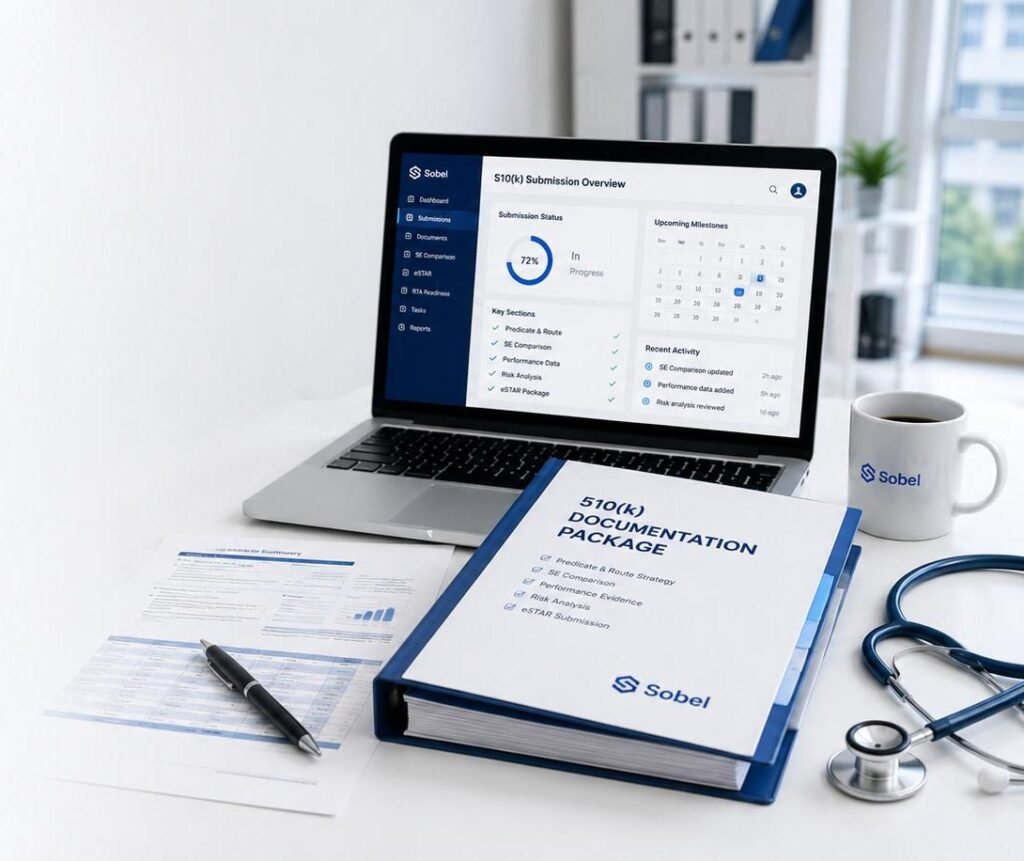
We help your team identify gaps in predicate strategy, claims, evidence mapping, and eSTAR readiness before your 510(k) package moves forward.
- Predicate and route strategy
- SE comparison and evidence mapping
- eSTAR organization and RTA readiness
Trusted by medical device, diagnostics and life sciences teams preparing for regulated markets.













Is this 510(k) support right for you?
This service is designed for teams preparing a U.S. 510(k) and looking for a clearer path before FDA review.
- You are preparing a U.S. 510(k) submission
- You need to confirm the right 510(k) route
- You are evaluating predicate options
- Your claims or evidence need alignment
- You want eSTAR-ready documentation before submission
If route, predicate, evidence or eSTAR structure are still uncertain, Sobel can help organize the next step.

Most 510(k) problems start before submission
A 510(k) must do more than collect data. It needs to show why your device is substantially equivalent to a legally marketed predicate and why any differences are supported by evidence.
Common issues
- Predicate rationale is weak
- Route selection is unclear
- Intended use or indications do not align
- Claims are broader than the evidence
- Technological differences are not explained

What it can cause
- RTA issues before substantive review
- Additional FDA questions
- Rework in labeling or comparison tables
- Delays in U.S. market access
- Internal uncertainty before submission
THE SOLUTION
Turn scattered device information into a structured 510(k) package
Sobel helps organize device information, labeling, claims and performance evidence into a clearer regulatory rationale for your 510(k).
- Clearer route decision and predicate strategy
- Stronger SE comparison and claims alignment
- Evidence mapped to key review questions
- Content structured for eSTAR readiness

What you receive
Your deliverables are designed to make the 510(k) logic easier to review, organize and defend internally.

Predicate & Route Memo
Clarify the path before building the file.
- Candidate predicate assessment
- Recommended 510(k) route
- Rationale for the selected pathway
SE Comparison & Claims Map
Connect predicate, intended use, technology and claims.

- Intended use and indications comparison
- Technological characteristics comparison
- Labeling and claims alignment
Performance Evidence Crosswalk
Show how your data supports the SE rationale.

- Evidence mapped to claims and SE questions
- Applicable standards and test expectations
- Gap identification before submission
eSTAR Package & RTA Readiness
Organize the package for acceptance review.

- Content organized by eSTAR sections
- Acceptance checklist preflight
- Handover package for your regulatory owner
Simple and structured 510(k) preparation
A clear workflow helps your team reduce uncertainty before the submission is assembled.
1
You send your device information:
We review intended use, indications, labeling, test data, risk information and candidate predicates.
2
We assess route and predicate options:
We evaluate the pathway and predicate strategy that best supports your SE case.
3
We build the SE comparison:
We structure the comparison of intended use, technology, performance and claims.
4
We organize the eSTAR package:
We align the content with FDA’s eSTAR structure and acceptance expectations.
5
You receive a review-ready package:
Your team receives the documentation, notes and handover needed to proceed.
Why companies choose Sobel
Specialized 510(k) support built around predicate strategy, substantial equivalence and eSTAR readiness.
Predicate and route logic before writing
We clarify the regulatory path before the documentation is assembled.
Technical writing for regulated evidence
We translate test data, labeling, claims and technology differences into clear regulatory arguments.
eSTAR and RTA-focused organization
We structure content around the format, prompts and acceptance logic FDA expects.
Support for RA/QA and product teams
We help internal teams align before submission, reducing confusion and rework.
Tell Us About Your 510(k)
Share where you are in the process. We’ll help identify the next step for your route, SE rationale and eSTAR readiness.
- Clear next steps
- No obligation
- Specialist review
Frequently asked questions
The best time is before the 510(k) package is fully assembled, especially if route, predicate, claims, evidence or eSTAR structure are still uncertain.
That is a common starting point. Sobel helps evaluate candidate predicates and organize the rationale for the option that best supports your substantial equivalence case.
The right route depends on your device, predicate, intended use, technological differences and available evidence. We help assess whether a Traditional, Special or Safety & Performance Based 510(k) is the most appropriate path.
We review the logic before the file is finalized, align claims with evidence, organize comparison tables and check whether eSTAR and RTA expectations have been addressed.
Yes. We can review the current structure, identify weak points in the SE rationale and help organize the content into a clearer eSTAR-ready package.
Part B is prepared and signed by a qualified safety assessor. This section includes the safety assessment, conditions of use, warnings and final safety conclusion.
This service is focused on regulatory strategy, documentation and package preparation. The official submitter role can be discussed separately depending on project structure and responsibilities.
