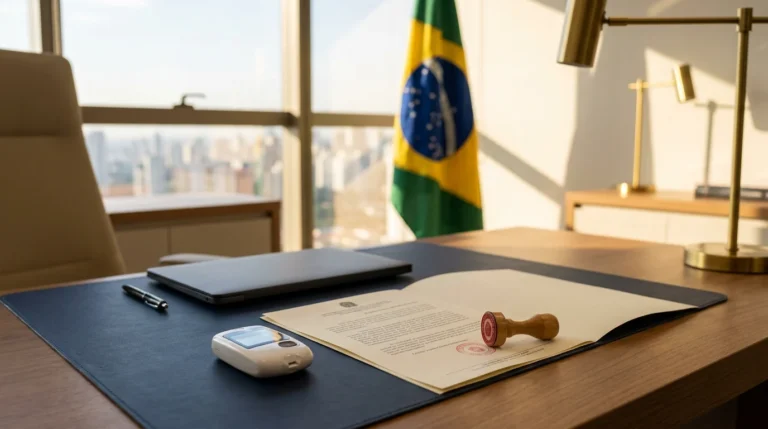

The application was filed months ago. At every board meeting someone asks “what about ANVISA?”, and the answer is always the same: “still under review”. The commercial plan has already been redone twice, and no one in the company can say whether this is the normal queue or whether something went wrong along the way.
Short answer: part of the wait is normal. ANVISA reviews applications in queues, and the time varies with the type of product, the type of application and the workload of the area. But a stalled application can also hide a problem: a technical requirement no one saw, an incomplete filing or an application in the wrong queue. The first thing is to find out which of the two is your case.
Why does ANVISA’s review take so long?
In most cases, because of the queue. Applications come in order and wait their turn to be assigned to a reviewer. The time depends on the type of product, the application category and how many similar applications are ahead. ANVISA offers, on its consultation portal, a service to follow the application queue, which helps as a reference.
The point few people notice: waiting in the queue is not the same as being stuck for no reason. And the two situations call for different actions.
Is this you? Do you know the exact filing date and the process number by heart? Does someone in the company check the status of the application regularly, or only when the board asks? Does the email registered to receive ANVISA communications still belong to someone who works at the company?
How do I know if my application is just in the queue or if there is a problem?
A few signs help tell one from the other.
| What you see | Usually the queue | Usually needs attention |
|---|---|---|
| Status in the system | “Awaiting review” or similar, unchanged | A recent movement no one understood |
| Communications | None, and the registration data are correct | The registered email is old or belongs to someone who has left |
| Waiting time | Within what the queue for that area usually shows | Far longer than similar applications filed at the same time |
| Filing | Complete, with the fee paid | Doubt whether a document or the fee was left out |
In Sobel’s view, the most delicate case is the technical requirement no one saw. Under RDC 204/2005, requirements are issued only electronically, ANVISA notifies the emails registered for the company and the application, and it is up to the company to check the system for requirements. If the deadline ends without an answer, the rule provides for rejection. In other words, the company may only discover the problem when it has already become a rejection. (What to do when a requirement arrives is in the guide on technical requirements.)
Is there a deadline for ANVISA to decide?
The answer depends on the type of product and application, and does not fit a single rule. One point applies to all: when ANVISA issues a technical requirement, the deadline to decide is interrupted, and the time that had already passed no longer counts. So an application that received a requirement may look delayed without being so.
In practice, the most useful question for the board is rarely “when will it be approved?”, because no one can guarantee that date. It is “is the application in order and in the right queue?”. That question has an answer.
What can you do while you wait?
More than it seems. Waiting well is different from waiting idle.
- Check the application. Current status, history of movements and whether a requirement is registered in ANVISA’s system. The rule assigns this check to the company itself.
- Check the registration data. The emails and contacts that receive ANVISA’s communications must be up to date.
- Check the filing. Whether the application was submitted with all documents and the correct fee. An incomplete filing can have a different outcome than expected.
- Assess whether priority review applies. Priority rules vary by product category and do not always exist for your case. When they do, the request must be well grounded.
- Prepare the next step. Many applications receive a requirement after the wait. Those who already have the manufacturer’s documents organized can answer calmly.
What not to do
- File a new application identical to the previous one to “jump the queue”. It does not speed up the review and can create two processes for the same product.
- Chase ANVISA without first checking your own application. The technical area’s first question is usually about what is already in the file.
- Make commercial decisions based on an imagined approval date. Plan with scenarios, not with a single date.
How Sobel can help
In the initial assessment, we check your application, its history and the filing, and tell you clearly what is queue and what needs action. If there is a pending requirement, a gap in the filing or room for a priority request, you know before time works against you. Our team works with medical devices, IVD and cosmetics and tracks every step in the Sobel Client Workspace.
Send the process number for an initial assessment. We reply within 1 business day. →
Frequently asked questions
How long does an ANVISA registration take? It depends on the type of product, the application category and the queue of the responsible area. There is no single number that applies to every case. ANVISA’s consultation portal lets you follow the application queue, and that is the place to start.
My application is stalled. Should I file again? In general, no. A second identical application does not speed up the review. Before filing anything, check the status of the application and whether any communication was missed.
How do I know if ANVISA sent a technical requirement? Requirements are issued electronically, in ANVISA’s system, and the agency notifies the emails registered for the company and the application. The rule makes clear that it is up to the company to check for requirements. Keeping registration data and emails up to date is part of managing the application.
Can I request priority review? It depends on the category. Priority rules vary by product type and do not always exist for your case. Assess before you ask.
The application was not filed by Sobel. Can you assess it? Yes. Many cases come to us after an application filed by the company itself or by another consultancy.
Official sources
- RDC No. 204/2005, applications, technical requirements and rejection (consolidated text on AnvisaLegis, in Portuguese)
- ANVISA: update to the application queue consultation system (in Portuguese)
For information only. This does not replace an assessment of your application.
Related service
How Sobel can help your productSee the service →
Written by
Maik Endler
Mechanical engineer trained in Germany and former BSI auditor (Notified Body). Founder and CEO of Sobel, he leads regulatory strategy for medical devices, IVDs and cosmetics in Brazil, Europe, the UK, the US and Canada.