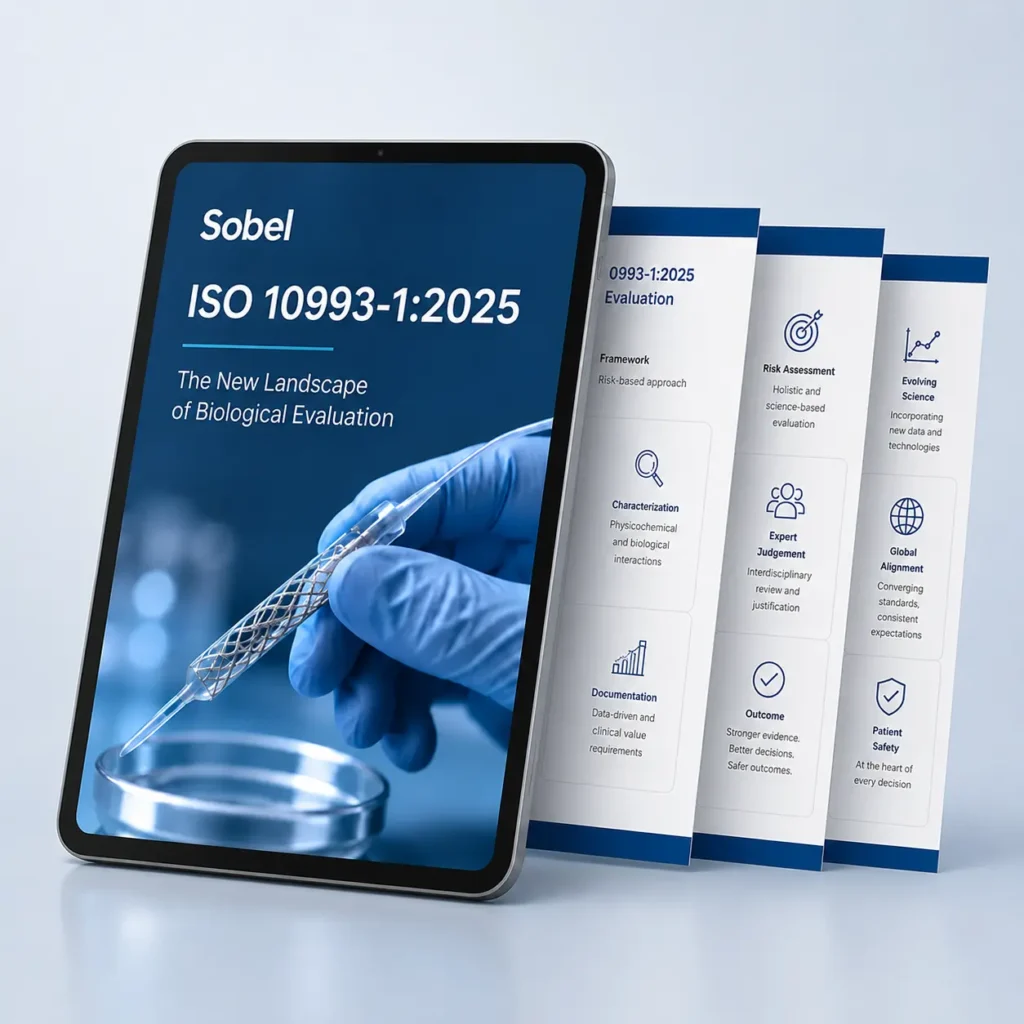

In the development and approval process of medical devices, three types of evaluations frequently appear in regulatory requirements: biological evaluation, clinical evaluation, and toxicological evaluation.
Although these approaches all aim to support the safety and effectiveness of a product, they serve distinct purposes. Understanding these differences is essential to meet the requirements of the FDA (U.S.), MDR (Europe), and Anvisa (Brazil).
In summary, Biological Evaluation aims to assess whether the materials used in the device may cause harm when in contact with the human body. Clinical Evaluation focuses on the product’s performance in real-world use, based on clinical data or patient studies. Finally, Toxicological Evaluation emerges as a complementary step within the biological evaluation, particularly when there is exposure to chemical substances.
In this article, we will explain how each of these evaluations works. You will also learn how to integrate them strategically to help streamline your device’s path to market.
TIP: Did you know that Sobel offers training on ISO 10993-1:2025 focused on Biological Evaluation? In addition, we provide other trainings focused on the European and Brazilian markets that can help your team develop a successful regulatory strategy.
What Is Biological Evaluation in Medical Devices?
Biological Evaluation is an essential step to assess whether a medical device may cause adverse effects when it comes into contact with the human body.
Most medical devices require this process, especially those with direct or indirect contact with tissues, body fluids, or organs.
The international regulatory foundation for this evaluation is ISO 10993-1:2025, a standard adopted by major regulatory authorities worldwide, such as the FDA (U.S.), the European Commission (MDR), and Anvisa (Brazil).
The standard defines the principles and requirements for evaluating the biocompatibility of materials used in medical devices.
What Does Biological Evaluation Assess?
The primary goal is to determine whether the materials:
- Are non-toxic (cytotoxicity);
- Do not trigger allergic or hypersensitivity reactions;
- Do not cause tissue irritation or inflammation;
- Do not release hazardous chemical substances (carcinogenic, mutagenic, or reproductive toxicity potential).
To achieve this, the following factors guide the assessment:
- The type of contact with the body (surface, invasive, implantable);
- The duration of contact (transient, short-term, prolonged, or permanent);
- The contact pathways (skin, mucosal surfaces, circulatory system, etc.).
These variables help determine which tests are required, according to the ISO 10993-1:2025 evaluation matrix.
Laboratory Testing vs. Risk-Based Approach

In the past, biological evaluation commonly relied on standardized animal testing.
However, with the evolution of ISO 10993, the focus has shifted toward a risk-based approach, prioritizing:
- The assessment of materials and their chemical composition;
- The analysis of existing data from the scientific literature;
- The use of in vitro testing and alternative methods to animal experimentation.
This approach requires manufacturers to develop a Biological Evaluation Plan and a technical report that justifies the tests performed (or waived), always based on scientific evidence.
Biological Evaluation Report (BER)
This technical document is a mandatory part of the regulatory dossier.
It should include a description of the device and the materials that come into contact with the body, as well as the device classification in terms of type and duration of contact.
In addition, it must present the results of the tests performed (or the justification for not performing them), along with the conclusion regarding the overall biocompatibility of the device.
The report must be signed by a qualified professional with expertise in toxicology, materials science, or biomedical engineering.
At Sobel, the entire Human Safety team holds the credentials required to sign technical documentation. It means a highly qualified and recognized team supporting your project.
Where Does Toxicological Evaluation Fit In?
Within Biological Evaluation, Toxicological Evaluation plays a key role. However, it deserves special attention because it involves an in-depth assessment of the chemical safety of the materials used in a medical device.
Toxicological Evaluation answers questions such as:
- Does the material in my device release chemical substances?
- Can these substances cause adverse effects, such as chronic toxicity or reproductive toxicity?
- Is user exposure within acceptable limits?
In other words, Toxicological Evaluation comes into play when the device contains potentially hazardous substances or when there is a release of chemical compounds through contact with the body.
When Is Toxicological Evaluation Required in the Process?
Toxicological Evaluation is directly linked to ISO 10993-17, which addresses the toxicological risk assessment of chemical compounds extracted from materials that come into contact with the human body.
It is typically required when:
- Substances are detected during chemical extraction testing;
- The device contains additives, plasticizers, or complex materials in its composition;
- The product comes into contact with blood, organs, or tissues for prolonged periods.
Typical Steps in Toxicological Evaluation
- Identification of chemical substances present in the material or released through extraction;
- Estimation of patient exposure (e.g., daily dose);
- Consultation of toxicological databases (such as ECHA, REACH, EPA, etc.);
- Calculation of the Tolerable Exposure (TE);
- Comparison between the estimated dose and the accepted limit to determine whether there is a significant risk.
If the risk is considered acceptable, the toxicological report is included in the Biological Evaluation. If not, material adjustments or engineering solutions may be required.
Toxicological Evaluation ≠ Laboratory Testing
It is important to understand that Toxicological Evaluation is a risk assessment—not a laboratory test.
For this reason, it relies on technical expertise in regulatory toxicology, access to scientific literature and up-to-date databases, and the ability to interpret the results of quantitative chemical testing.
In this context, the evaluation is typically conducted by certified toxicologists. And the resulting report becomes a critical component of the regulatory approval process.
What Is Clinical Evaluation in Medical Devices?
Clinical Evaluation is the systematic process of collecting, analyzing, and interpreting clinical data to demonstrate that a medical device is safe and effective for its intended use.
Unlike Biological Evaluation, which focuses on how materials interact with the body, Clinical Evaluation addresses a central question: does the device actually perform as intended in real patients?
This evaluation is required for most medical devices and is directly tied to demonstrating clinical performance and patient benefit.
What Does Clinical Evaluation Assess?
Clinical Evaluation aims to demonstrate three main pillars:
- Clinical safety: the device does not pose unacceptable risks to the patient;
- Performance: the device performs according to the manufacturer’s claims;
- Clinical benefit: the use of the device provides real advantages for the patient or user.
To support this, different types of data can be used, such as published scientific literature, clinical data from equivalent devices, and post-market experience. Clinical investigations conducted by the manufacturer may also be included.
In practice, each of these data sources enables a specific strategy.
With scientific literature data, published studies are used to demonstrate the safety and performance of the device.
In clinical equivalence, it is demonstrated that the device is equivalent to another already marketed device based on technical characteristics, composition, or intended use.
Finally, it is possible to conduct proprietary clinical studies; however, these are required when there is insufficient data in the literature, when the device is innovative, or when there are significant changes in design or intended use.
Clinical Evaluation Report (CER)
The outcome of this process is the Clinical Evaluation Report (CER), a mandatory document within the regulatory dossier.
It should include:
- A detailed description of the device
- Definition of the intended use
- Strategy for searching and selecting clinical data
- Critical analysis of the available evidence
- Conclusion on safety, performance, and clinical benefit
In addition, the CER is not a static document—it must be updated throughout the product lifecycle based on post-market data.
This is a key point: Clinical Evaluation does not end with product approval.
It is part of an ongoing process that includes PMS (Post-Market Surveillance) and PMCF (Post-Market Clinical Follow-up), which involve continuous monitoring and collection of clinical data.
This approach helps identify emerging risks, confirm performance, and maintain regulatory compliance over time.
How to Strategically Integrate Biological, Clinical, and Toxicological Evaluations

Although addressed separately in technical documentation, Biological, Clinical, and Toxicological Evaluations are part of an integrated body of evidence that demonstrates the safety and effectiveness of a medical device.
For this reason, manufacturers who understand how to connect these stages from the beginning can optimize timelines, reduce testing, and strengthen their regulatory submissions.
Strategic integration of these evaluations is not just recommended—it is expected by the world’s most stringent regulatory authorities.
- Biological Evaluation addresses whether the device materials are safe for contact with the human body.
- Toxicological Evaluation, as part of Biological Evaluation, analyzes whether released chemical substances pose a health risk.
- Clinical Evaluation demonstrates whether the device performs its intended function safely and provides real benefit to the patient, using real-world or equivalent data.
Tips for Efficiently Integrating These Evaluations:
- Use risk management as the central foundation: all evaluations should be based on risk management (ISO 14971). This means that the biological evaluation plan, toxicological justification, and clinical evaluation should stem from the same identified hazards, follow the same risk prioritization logic, and remain consistent in defining controls and acceptable limits.
- Plan evaluations from the development phase: avoid waiting until the registration stage to start addressing testing requirements.
- Leverage existing data and scientific literature: many tests can be replaced with data from equivalent products, published studies, or previous evaluations, as long as material or use equivalence is technically justified.
- Develop integrated and well-structured reports: technical documents such as the Biological Evaluation Report (BER), Toxicological Risk Assessment (TRA), and Clinical Evaluation Report (CER) should align with each other and present consistency in data, rationale, and conclusions.
- Consider specialized support: for moderate- to high-risk devices, working with consultants experienced in ISO 10993-1:2025, toxicology, and clinical evaluation can save time and help meet international regulatory expectations. Sobel has a Human Safety team with hundreds of successfully conducted and completed projects—reach out to us to get this support.
Evaluations That Support Safety
Understanding the differences between biological, clinical, and toxicological evaluations is essential for professionals involved in the development, registration, or regulation of medical devices.
Although distinct, these three approaches are complementary and become even more effective when integrated from the early stages of a project.
By adopting a risk-based approach, using international standards such as ISO 10993-1, and planning regulatory strategies in advance, manufacturers can optimize timelines, reduce costs, and improve their chances of success in global submissions.