
ANVISA has opened a new opportunity for manufacturers of innovative medical devices seeking a clearer regulatory path in Brazil. In August 2026, the Agency launched a new public call for its pilot project focused on the regulatory evaluation of innovative medical devices.
You can access the official ANVISA announcement here:
ANVISA launches new public call for the regulatory evaluation of innovative medical devices
At first glance, this initiative may seem relevant only to highly specialized manufacturers. However, it may represent a strategic opportunity for companies developing high-risk technologies and looking to enter the Brazilian market with greater predictability.
In other words, this is not just another regulatory update. Rather, it is a sign that ANVISA is continuing to create mechanisms to engage earlier with innovation and improve regulatory alignment for complex products.
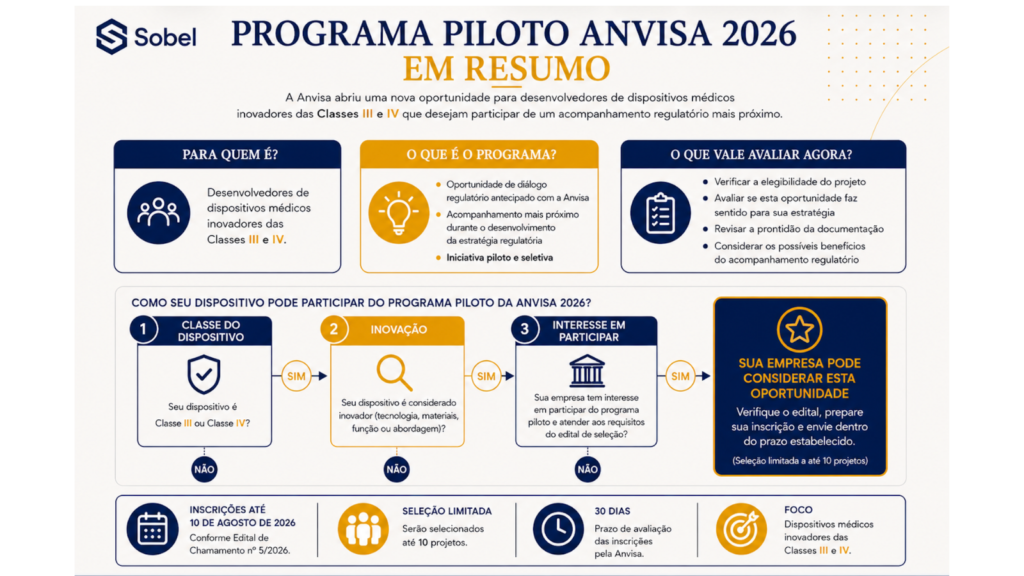
What is ANVISA’s 2026 pilot program?
ANVISA’s new public call is part of a pilot initiative designed to support the regulatory evaluation of innovative medical devices in Brazil. According to the Agency, up to 10 projects may be selected.
More specifically, the initiative is aimed at Class III and Class IV medical devices, especially those that present a higher degree of innovation or technological complexity.
This includes, for example:
- devices that incorporate artificial intelligence;
- products with new biomaterials;
- advanced monitoring systems;
- and other solutions that bring relevant technological innovation to healthcare.
Therefore, the program is especially important for companies whose products may not fit neatly into more traditional regulatory pathways or whose submissions may benefit from earlier regulatory discussion.
Why does this matter for manufacturers?
For manufacturers, one of the biggest challenges in any market is regulatory uncertainty. This is particularly true when the device is innovative, high-risk, or based on emerging technology.
Because of that, a pilot program like this may create value well before a formal submission is filed.
First, it allows companies to better understand ANVISA’s expectations for complex or novel technologies.
Second, it may help identify potential regulatory gaps earlier in the process.
In addition, it can support more strategic planning around technical documentation, clinical evidence, risk management, and product classification.
From a business perspective, this matters because a stronger regulatory strategy often leads to fewer surprises, better preparation, and more efficient market entry planning.
Who should pay close attention to this update?
This update is particularly relevant for:
- manufacturers of Class III and IV medical devices;
- companies developing innovative products for the Brazilian market;
- organizations working with AI-based medical technologies;
- businesses using advanced materials or new technical approaches;
- and global manufacturers evaluating Brazil as part of their market expansion strategy.
Even if a company is still defining its regulatory roadmap, this pilot program may be worth evaluating. After all, early positioning can make a substantial difference when dealing with innovative technologies.
What should companies evaluate now?
Before taking action, companies should assess whether their product and regulatory maturity align with the objectives of the program.
For example, manufacturers should consider:
1. Device classification
To begin with, confirm whether the product falls within Class III or Class IV, since these are the classes covered by the initiative.
2. Innovation profile
Next, assess what makes the device innovative from a regulatory standpoint. Is it the technology, the intended use, the material, the software logic, or a combination of these elements?
3. Technical documentation readiness
At the same time, review how mature the technical file is. ANVISA will likely expect a coherent level of technical substantiation, even within a pilot context.
4. Clinical and performance evidence
In addition, evaluate whether there is sufficient evidence to support safety, performance, and intended use. This is especially relevant for more complex or novel products.
5. Regulatory strategy for Brazil
Finally, determine whether participation in the program fits the company’s broader regulatory and commercialization plan for Brazil.
Taken together, these elements can help manufacturers decide whether this opportunity should become part of their market access strategy.
What does this signal about the Brazilian market?
More broadly, this initiative reflects a relevant movement in the Brazilian regulatory environment.
On the one hand, ANVISA continues to maintain a high standard for safety and regulatory scrutiny. On the other hand, the Agency is also showing increased openness to innovation and more structured engagement with emerging technologies.
As a result, Brazil becomes an even more important market for manufacturers that want to expand in Latin America while maintaining regulatory credibility.
For international companies, this is also a sign that regulatory strategy in Brazil should not be treated as an afterthought. Instead, it should be planned early, especially when the product is novel or technically sophisticated.
How Sobel can support your regulatory strategy
At Sobel, we help manufacturers navigate regulatory pathways for medical devices in Brazil and other global markets.
If your company is evaluating this new ANVISA pilot opportunity, our team can support you with:
- regulatory strategy assessment;
- product classification analysis;
- gap assessment for technical documentation;
- evidence planning;
- and support for market entry preparation in Brazil.
Most importantly, we help translate regulatory requirements into practical next steps, so your team can move forward with greater confidence.
Final thoughts
ANVISA’s 2026 pilot program for innovative medical devices is a relevant development for manufacturers of high-risk and emerging technologies.
More than a regulatory announcement, it is a strategic signal. Companies that act early may be in a better position to understand expectations, reduce uncertainty, and prepare more effectively for the Brazilian market.
If you are developing an innovative medical device and considering market access in Brazil, this is the right time to review your regulatory strategy.
Need support evaluating your next step with ANVISA? Contact Sobel to discuss your regulatory pathway for Brazil.