ANVISA has published RDC No. 1,030/2026, updating the list of substances that may not be used in personal hygiene products, cosmetics, and perfumes.
More than a regulatory update, this change requires attention from companies operating in the cosmetics sector, especially teams responsible for regulatory affairs, quality, R&D, product development, and portfolio management.
This is because regulatory compliance is not only about monitoring the publication of a new rule. In practice, it may affect formulations, ingredients, already regularized products, and the internal planning required to meet the established deadlines.
What is RDC No. 1,030/2026?
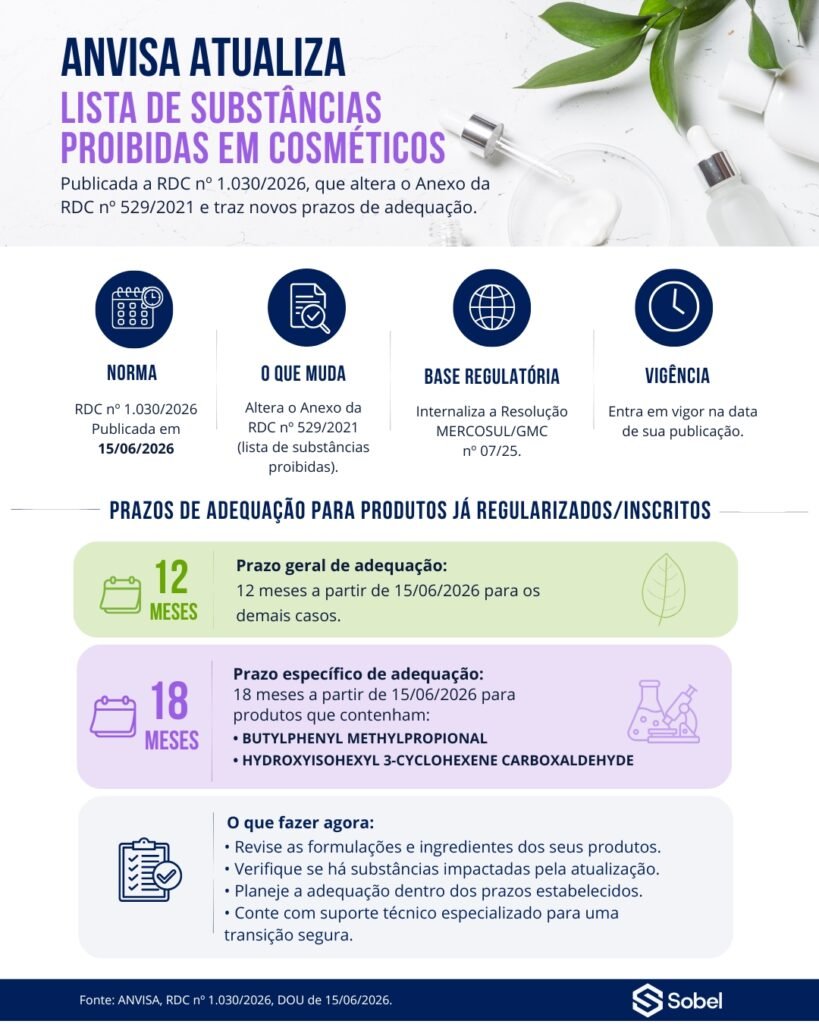
RDC No. 1,030/2026 amends the Annex of RDC No. 529/2021, which establishes the list of substances prohibited in personal hygiene products, cosmetics, and perfumes.
In addition, the regulation internalizes MERCOSUR/GMC Resolution No. 07/25, aligning the Brazilian regulatory framework with the update established within Mercosur.
Therefore, companies that manufacture, import, distribute, or regularize cosmetic products in Brazil should assess whether their products may be impacted by this update.
What Changes for Cosmetics Companies?
The main change is the update to the list of substances prohibited for use in cosmetics, personal hygiene products, and perfumes.
As a result, companies need to verify whether their formulations contain ingredients included or affected by the new regulation.
In practice, this analysis may involve:
- technical review of formulations;
- verification of the ingredients used;
- assessment of the portfolio of regularized products;
- identification of products that require adaptation;
- planning of reformulation, when applicable;
- organization of internal regulatory deadlines.
This process is important because adaptation should not be addressed only at the protocol stage. It starts earlier, with the technical and regulatory review of the product.
What Are the Adaptation Deadlines?
RDC No. 1,030/2026 establishes a 12-month deadline for the adaptation of products already regularized/registered, counted from the publication date of the resolution, on June 15, 2026.
However, there is an important exception.
For products already regularized with ANVISA that contain BUTYLPHENYL METHYLPROPIONAL or HYDROXYISOHEXYL 3-CYCLOHEXENE CARBOXALDEHYDE, the adaptation deadline is 18 months, also counted from the publication date of the resolution.
For this reason, cosmetics companies should assess their products in advance to understand which deadlines apply to each case.
Why Is This ANVISA Update Important?
This update is relevant because it may directly impact the compliance of cosmetic products in the Brazilian market.
When a substance becomes part of the list of prohibited substances, the company needs to assess whether any products are affected and what measures will be necessary for compliance.
In addition, non-compliance with the provisions established in the resolution may constitute a sanitary violation, as indicated in the regulation itself.
Therefore, monitoring ANVISA regulatory updates is essential to reduce risks, avoid rework, and keep the product portfolio compliant.
What Should Companies Do Now?
The first step is to conduct a technical assessment of the product portfolio.
This analysis should consider current formulations, ingredients used, already regularized/registered products, and the applicable deadlines for each case.
Next, it is important to define a regulatory action plan, considering priorities, risks, potential reformulation needs, and commercial impact.
Key points of attention include:
- identifying products that contain substances included in the update;
- checking for the presence of BUTYLPHENYL METHYLPROPIONAL or HYDROXYISOHEXYL 3-CYCLOHEXENE CARBOXALDEHYDE;
- classifying products according to the applicable deadline;
- assigning internal responsibilities for the adaptation process;
- planning possible formulation adjustments;
- keeping technical and regulatory documentation organized.
Regulatory Compliance Is Also Strategy
In the cosmetics sector, regulatory compliance must be connected to product strategy.
An update such as RDC No. 1,030/2026 may affect formulations, timelines, product launches, product continuity, and commercial decisions.
For this reason, companies that anticipate regulatory impacts can act with greater confidence, reduce risks, and make more structured decisions.
At Sobel, we understand that product regularization does not begin with the protocol. It begins with technical review, correct interpretation of the regulation, and planning the decisions that come before it.
Conclusion
The publication of RDC No. 1,030/2026 reinforces the importance of maintaining an active regulatory monitoring routine in the cosmetics sector.
Companies operating with personal hygiene products, cosmetics, and perfumes should evaluate their formulations, review their portfolio, and organize an adaptation plan within the deadlines established by ANVISA.
More than meeting a requirement, this process strengthens regulatory safety, product quality, and the company’s responsibility toward the market.
Product regularization does not begin with the protocol. It begins with technical review.
Need Support to Assess the Impact of This Update?
If your company needs to review formulations, assess its portfolio, or understand which products may be impacted by RDC No. 1,030/2026, Sobel can support this process with a structured technical and regulatory analysis.
Contact us to understand how to conduct the adaptation process with greater clarity, safety, and planning.