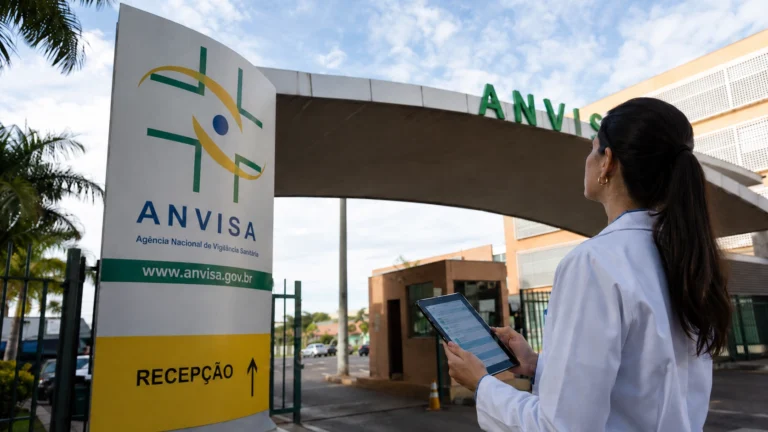

The company notified the device. It appeared in the Official Gazette and was already on sale in Brazil. Months later, a message arrives from ANVISA: the company needs to adjust the notification and has 30 days to answer. The team opens the file to check the claims on the label and realizes no one can find the document behind one of them. This is the part of ANVISA notification requirements that catches many companies out.
Short answer: notification is ANVISA’s route for Class I and II medical devices, and it has no mandatory technical review. That does not mean it has no requirements. The device’s technical documentation must support everything you declare in the form, on the labeling and in the instructions for use, because ANVISA can audit the file at any time. Before publication, a gap leads straight to rejection. After publication, it leads to a request with a 30-day deadline and, without an answer, to cancellation.
What ANVISA notification requirements really include
Under RDC 751/2022, Class I (low risk) and Class II (medium risk) medical devices go to market exclusively through notification (notificação), with no registration required. A company established in Brazil with an ANVISA operating licence (AFE) files the application, and ANVISA processes it routinely within 30 days.
What goes into the filing, under Article 13 of RDC 751/2022:
- The notification form, fully completed and signed electronically by the legal and technical responsible persons.
- For imported devices, the legal manufacturer’s declaration authorizing the Brazilian company to represent and sell the device, apostilled or consularized, in Portuguese, English or Spanish or with a sworn translation.
- A conformity certificate, only for devices under compulsory certification, such as hypodermic syringes and needles, gloves and infusion sets.
- Proof of compliance with specific technical regulations, when they apply to the device.
You do not file the technical dossier in full, but the filing stands on it. ANVISA’s new manual for notified devices sets out, field by field, where each piece of information must come from. Clinical data from a clinical evaluation must support the indication of use. The shelf life must come from stability studies. Warnings, precautions and contraindications must come from the device’s risk management. And even a company that does not need to present a GMP certificate must still meet RDC 665/2022 and keep the evidence available.
In other words, ANVISA notification requirements are not only what you file. They are also everything the filing claims.
Preparing an ANVISA notification?
Send your notification form and labeling. A specialist checks whether every claim has evidence behind it. We reply within 1 business day.
What happens if ANVISA audits your notification?
Under Article 10 of RDC 751/2022, ANVISA considers notified devices regularized without technical review. The same article keeps ANVISA’s right to assess the documentation at any time, before or after publication. What changes is the moment:
| Audit before publication | Audit after publication | |
|---|---|---|
| When it happens | While ANVISA processes the application | Any time after ANVISA publishes the notification in the Official Gazette |
| What ANVISA can find | Missing or incomplete documents, forms with blank fields, outdated documents, no conformity certificate when required, no clinical evidence for an innovative technology or indication | Inconsistencies or information that needs to be completed |
| What happens | Summary rejection (indeferimento), with no request for correction | A request for adjustment (notificação de adequação), with 30 days from its issue to answer |
| If it is not resolved | The company can appeal within 30 days or file a new application | ANVISA cancels the notification |
The 30 days run from the date ANVISA issues the request, and it is the company’s job to check ANVISA’s system for it. A request that sits unread in an inbox can cost the notification, so monitoring is part of meeting ANVISA notification requirements too.
If the application has already been rejected, the guide on rejection explains the two paths and the appeal deadline.
ANVISA notification requirements in practice: what the new manual changes
 SOBEL EXPERTRafaela CavalcantiRegulatory Affairs Analyst at SobelPrepares and reviews ANVISA notifications and technical dossiers for medical devices.
7 years in regulatory affairs.Connect with Rafaela on LinkedIn →
We asked Rafaela what ANVISA’s new manual on notification means in practice.
What is the most common gap against ANVISA notification requirements?
Honestly, the one I see most is a mismatch between what is declared and what there is evidence for. You read the label, the instructions for use, the form itself, and some of that information just isn’t backed by the technical documentation. And it’s not only clinical claims. Any information you declare needs a document in the dossier behind it.
Two other things come up a lot. One is treating notification as just a form: the company files, gets published and forgets the dossier. But RDC 751/2022 requires you to keep it, even for Class I and II devices. The other is notifying a device with an innovative technology or indication without clinical evidence. The manual itself lists that as one of the main reasons for rejection.
What does the new manual clarify that used to cause doubt?
The big help is that it goes field by field and says what ANVISA expects in each one. Before, the same field was filled in very differently from one company to another. It also lists the main reasons for rejection, and those come from real data, from Datavisa and from audits.
Can you tell us about a case you have seen in practice?
I remember a case that really stuck with me. It involved a product subject to notification, and many people assume that because notification doesn’t require a mandatory prior technical review, the process is simpler or carries less risk.
The product was duly notified, but it eventually came under Anvisa’s review. That’s when an important question came up about the regulatory classification that had been chosen.
Up to that point, the strategy seemed to make sense. But when the Agency took a closer look at the case, it determined that the product’s characteristics were not consistent with the chosen classification. As a result, the notification was rejected.
It was a huge learning experience for me. I realized that the real regulatory challenge isn’t just completing a notification or filling out a form correctly. It’s being able to technically justify every decision made, especially the rationale behind the product’s regulatory classification.
Since then, whenever I review a notification, I try to look beyond the form itself. My concern isn’t just whether the information has been entered correctly, but whether there’s solid documentation to back it up. After all, the form is just the tip of the iceberg. What really provides regulatory confidence is being able to support every piece of information when someone asks, “How did you reach that conclusion?”
Today, whenever I work on a regulatory strategy, I try to put myself in the regulator’s shoes and ask one simple question: if this product were audited tomorrow, would I be able to technically defend every decision that was made?
If you could give a manufacturer one tip before notifying, what would it be?
Build the technical dossier first, before you touch any form, even if it’s a notification product. Then go through every piece of information that will show up on the label, in the instructions for use and in the form, and check it against that dossier. If a sentence has no evidence behind it, take it out. That’s what makes the device hold up in an audit, not just at filing.
Is this you? Can you point to the document behind every sentence on your label and in your instructions for use? Did you have the technical dossier ready before you filled in the form, or are you putting it together afterwards? Does your device have an innovative technology or indication, and do you have clinical evidence for it?
How to check ANVISA notification requirements before filing
Rafaela’s tip, turned into a review you can run before the application goes in:
- Confirm the pathway. Check that the product is a medical device, that it is Class I or II under the 22 rules of RDC 751/2022, and that it falls under materials, not equipment, software or IVDs. Incorrect classification is on the manual’s list of reasons for rejection, and it can also lead to cancellation after publication.
- Build the dossier first, then write the form from it. Risk management, stability studies, clinical evaluation, test reports and the standards applied should exist before the first field is filled in. You should be able to trace each field to a document, not to the brochure.
- Cross-check the form, the labeling and the instructions for use against the dossier and against each other: name, models, indication of use, shelf life, storage conditions, warnings and contraindications. For each claim, ask where the proof is.
- Check the formal items on the checklist: qualified electronic signatures of the legal and technical responsible persons, the manufacturer’s declaration with apostille and translation, the models spreadsheet and the conformity certificate when it applies.
After publication, two more points keep the notification standing: upload the instructions for use to ANVISA’s document repository within 30 days, consistent with what you notified, and monitor ANVISA’s system for requests.
For the errors that stall applications in general, see the dossier errors that stall ANVISA applications most.
How Sobel can help
We prepare and review ANVISA notifications for medical devices against ANVISA notification requirements, from classification to the cross-check between the form, the labeling and the technical dossier. If your device is already notified, we can check whether the file would hold up in an audit before ANVISA asks. For manufacturers abroad, our independent Brazilian Registration Holder service can hold the notification.
Frequently asked questions
Does an ANVISA notification go through technical review? No. Under RDC 751/2022, ANVISA considers notified devices regularized without technical review. ANVISA can still assess the documentation at any time, before or after publication.
Do ANVISA notification requirements include a technical dossier for Class I and II devices? Yes. You do not file it in full, but the form, the labeling and the instructions for use must be consistent with it, and it must be available if ANVISA audits the notification.
Can ANVISA cancel a notified device? Yes. RDC 751/2022 provides for cancellation when the company does not answer a request within 30 days, when information or documents are missing, when the classification is wrong or when information proves to be false, among other cases.
Do Class I and II devices need clinical evidence? The indication of use must be supported by clinical data from a clinical evaluation. For devices with an innovative technology or indication, the lack of clinical evidence is one of the reasons for rejection listed in ANVISA’s manual. See our page on clinical evaluation for Brazil.
Does an ANVISA notification need to be renewed? No. A notification does not expire, but the device on the market must match what you notified, and you must file changes with ANVISA before you implement them.
Official sources
- Manual on the regularization of health-use materials subject to notification, GEMAT, ANVISA, 2026 (in Portuguese)
- RDC No. 751/2022, classification, notification and registration of medical devices (AnvisaLegis, in Portuguese)
- RDC No. 266/2019, administrative appeals at ANVISA (AnvisaLegis, in Portuguese)
For information only. This does not replace an assessment of your case.
Related service
How Sobel supports medical devicesSee the service →
Written by
Maik Endler
Mechanical engineer trained in Germany and former BSI auditor (Notified Body). Founder and CEO of Sobel, he leads regulatory strategy for medical devices, IVDs and cosmetics in Brazil, Europe, the UK, the US and Canada.