Your devices have been on the EU market for years. They have valid certificates, a technical file and a vigilance process. But if they are not yet registered, the EUDAMED deadline in 2026 is now about 60 days away. For many teams, the registration itself is not the hard part. The hard part is discovering, late, that a prerequisite is missing.
The short answer: devices whose first unit was placed on the EU market before 28 May 2026, and which continue to be placed on the market, must be registered in the EUDAMED UDI/Device module within 12 months of the notice published on 27 November 2025. To be safe, complete the registration no later than 27 November 2026.
At a glance
| Topic | What you need to know |
|---|---|
| What changes | Registration of devices already on the market becomes a legal obligation in the EUDAMED UDI/Device module. |
| Who is affected | Manufacturers of legacy devices (MDD, AIMDD, IVDD) and MDR/IVDR devices first placed on the market before 28 May 2026 that are still being placed on the market. |
| Deadline | Within 12 months of the notice published on 27 November 2025. Recommended date: 27 November 2026. |
| Prerequisite | Actor registration and a Single Registration Number (SRN). Non-EU manufacturers also need an active authorised representative. |
| What you need to do | Confirm your SRN, list the affected devices, prepare the device data and register each device identifier. |
| Official source | European Commission Q&A on the gradual roll-out of EUDAMED (Q7). |
Which devices must be registered before the EUDAMED deadline in 2026?
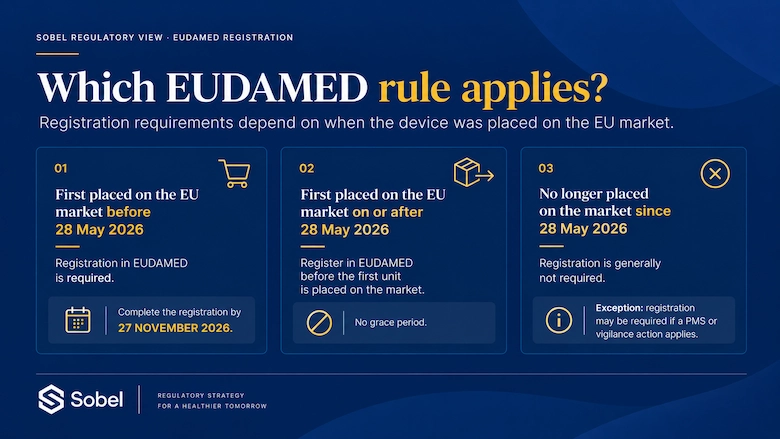
The answer depends on when the first unit of each device was placed on the EU market. The European Commission Q&A describes three situations.
- First placed on the market on or after 28 May 2026. The device must be registered in the UDI/Device module before the first unit is placed on the market. There is no grace period.
- First placed on the market before 28 May 2026 and still being sold. This is the group with the November deadline. The obligation applies to legacy devices and to MDR/IVDR devices.
- No longer placed on the market since 28 May 2026. Registration is not required, unless a post-market surveillance or vigilance action occurs (see below).
There is one important exception for legacy devices. A legacy device does not need its own registration if “the same device” is already registered as an MDR/IVDR device. The Commission defines “the same device” by shared identification, such as the UDI-DI, catalogue or reference number, or trade name. If the MDR/IVDR version received a new UDI-DI because of design changes, it is not “the same device”, and both must be registered.
Registration happens at the level of the device identifier, not the individual unit. One registration per UDI-DI (or EUDAMED ID for legacy devices) covers all units with different lot or serial numbers.
Is the EUDAMED deadline in 2026 on 27 or 28 November?
The official documents set the rule but do not write the final date in full. The Commission Q&A states the period as “within 12 months” of the notice publication. Its worked example suggests that the deadline falls one day after the anniversary, which would be 28 November 2026. However, MDCG 2026-4 describes a parallel 12-month transition period for notified bodies as “ending on” 27 May 2027, which follows the anniversary date.
Our recommendation is simple: plan to complete every registration by 27 November 2026. Treating the earlier date as your deadline removes the risk completely.
What must be in place before you can register a device?
Device registration is the last step, not the first. Before you can register any device, these elements must be ready:
- Actor registration and SRN. The manufacturer must be registered in the Actor module, and the national competent authority must validate the request. EUDAMED only generates the SRN after this validation, so this step depends on the authority’s review time.
- An active authorised representative (non-EU manufacturers). Non-EU manufacturers must have an active authorised representative and submit a mandate summary document with their actor registration request.
- A signed declaration on information security responsibilities. The Commission requires all actors to upload this declaration.
- Consistent device data. The device information in EUDAMED must match your labelling, Instructions for Use and certificates.
Is this you?
- You still sell devices under an MDD, AIMDD or IVDD certificate during the transition period.
- You are a non-EU manufacturer, and you have not confirmed that your authorised representative mandate is active and documented in EUDAMED.
- The person who created your Actor registration has left the company, and nobody currently has access.
- You do not have a complete list of which UDI-DIs or legacy devices are still being placed on the EU market.
If you answered yes to any of these, your registration plan needs to start this week, not in November.
What happens if a vigilance event involves an unregistered device?
The Post-Market Surveillance and Vigilance module is not yet available. Until it becomes mandatory, manufacturers must continue to use the national vigilance processes.
However, once that module is in use, a device that was not registered must be registered before the manufacturer can report the event in EUDAMED. This includes devices that are no longer sold. The Commission also explains that a legacy device must be registered exceptionally if a vigilance action concerns the legacy device itself and not “the same” MDR/IVDR device. In practice, keeping a complete and accurate device list protects you even for products that you have stopped selling.
What comes after the EUDAMED deadline in November 2026?
The November deadline is not the end of the EUDAMED work. Two further milestones from MDCG 2026-4 affect the same devices:
- Summary of Safety and (Clinical) Performance (SS(C)P). Manufacturers can upload SS(C)Ps from October 2026. For devices placed on the market before mandatory use, the upload should happen as soon as possible and no later than 27 February 2027.
- Certificates. Notified bodies have a transition period ending on 27 May 2027 to upload certificates issued before mandatory use. Until then, some devices will appear in EUDAMED without a linked certificate, and certain device data only becomes public after the certificate is entered.
For this reason, align your timeline with your notified body now. Your device registration and their certificate upload are connected.
In practice
Consider a manufacturer based outside the EU that sells a Class IIb surgical device in Europe under an MDD certificate. The regulatory team plans to register the device in October. During preparation, the team discovers that the authorised representative mandate was renewed last year, but the mandate summary document in EUDAMED still refers to the old agreement. The Actor data must be corrected first, and the correction depends on validation by the competent authority. A task that looked like two days of data entry becomes a four-week dependency. Starting with the Actor data, not the device data, avoids this situation.
What to do now: a 60-day plan for the 2026 EUDAMED deadline
- Week 1: Confirm that your Actor registration is valid, that your SRN is active and that at least two people in the company have access.
- Week 1 (non-EU manufacturers): Confirm with your authorised representative that the mandate is active and correctly documented in EUDAMED.
- Weeks 2–3: List every device still being placed on the EU market. For each one, record the UDI-DI or legacy identifier and whether “the same device” is already registered under the MDR/IVDR.
- Weeks 3–6: Prepare and check the device data against your labelling, Instructions for Use and certificates. Register the devices in batches, starting with the highest-volume products.
- Weeks 6–8: Resolve errors and pending items, align the SS(C)P upload with your notified body, and keep evidence of every registration.
How Sobel can help
Sobel Consult acts as EU Authorised Representative for manufacturers outside the European Union and supports the full EUDAMED process: Actor registration, mandate documentation, device data preparation and registration of legacy and MDR/IVDR devices. If your team needs to confirm what is still missing, we can review your current EUDAMED status and give you a clear plan for the remaining weeks.
If this is a topic for your team right now, we would be glad to talk. Get in touch with us.
Frequently asked questions
Do I need to register a device that I stopped selling before 28 May 2026?
No, unless a post-market surveillance or vigilance action occurs for that device. In that case, the manufacturer must register it, and must first be registered as an actor, in order to report the event.
Do distributors need to register in EUDAMED?
No. Distributors are not required to register in EUDAMED. However, they may still need to register at national level in the Member States where they make devices available.
Is national registration still required?
Until the UDI/Device module became mandatory, national registration requirements could apply. Once the module is mandatory, the registration in EUDAMED becomes the legally required registration.
Does each individual unit or lot need a separate registration?
No. EUDAMED registers devices at the level of the device identifier. One registration per UDI-DI, or EUDAMED ID for legacy devices, covers all units with different production identifiers.
Official sources
- European Commission – Q&A on the gradual roll-out of Eudamed
- European Commission – The EUDAMED four first modules will be mandatory to use as from 28 May 2026
- Commission Decision (EU) 2025/2371
- Regulation (EU) 2024/1860
- MDCG 2026-4
- European Commission – Actor registration module
- European Commission – UDI/Device registration
This article provides general information based on official EU documents available on the date of publication. It does not replace an assessment of your specific devices and situation. The Commission Q&A states that it has not been formally endorsed by the European Commission and is without prejudice to interpretation by the courts.