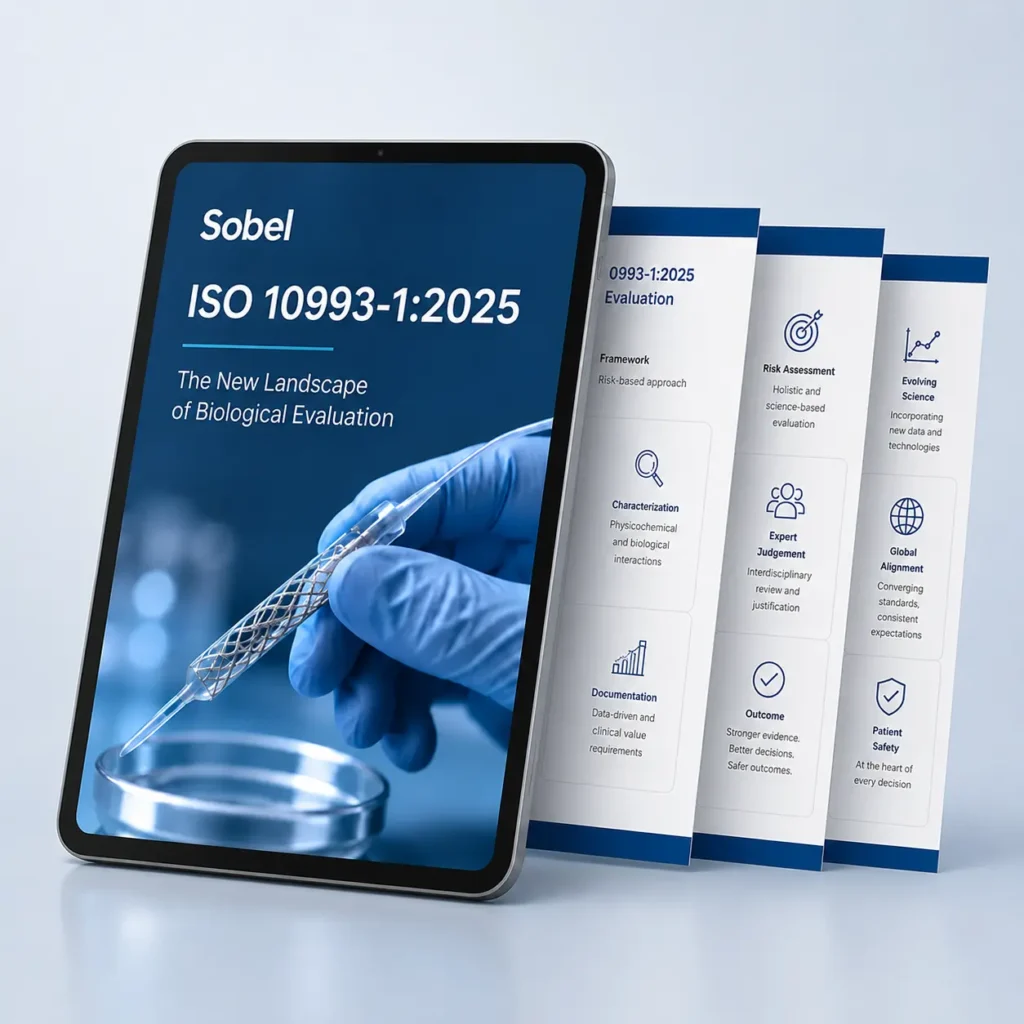
News: ISO 10993-1:2025 Is Now ABNT NBR – What It Means for ANVISA
Maik Endler
Read:
6
min
Share:
ISO 10993-1:2025 is now ABNT NBR in Brazil. See what changes in biological evaluation for ANVISA registration.
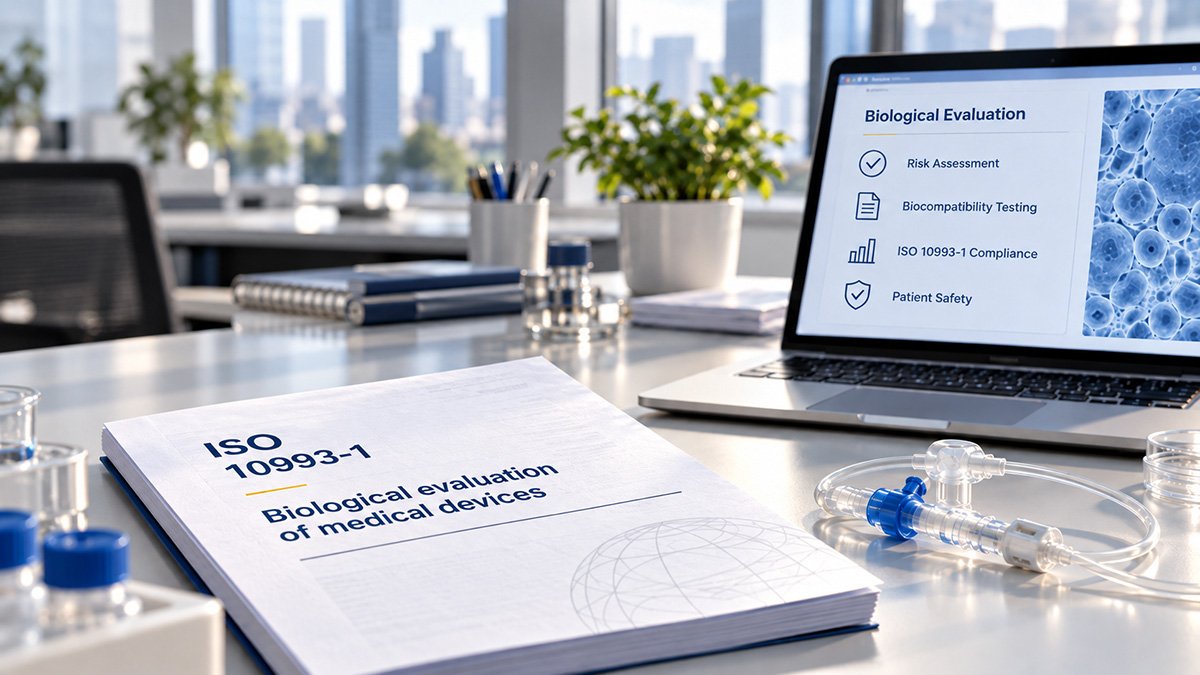
In September 2026, ABNT published the new edition of ABNT NBR ISO 10993-1, the Brazilian standard for the biological evaluation of medical devices. Since then, the question we hear most from manufacturers is simple: do we need to repeat our biocompatibility tests?
In most cases, no. However, the new NBR is now the Brazilian reference, and ANVISA’s essential requirements ask manufacturers to assess the impact of changes in the state of the art on risk management. Therefore, we recommend reviewing your biological evaluation and documenting whether it remains valid under the new edition.
What changed with the new ABNT NBR ISO 10993-1?
The new edition corresponds to ISO 10993-1:2025, the sixth international edition of the standard. In addition, the title changed to “Requirements and general principles for the evaluation of biological safety within a risk management process”. In other words, the new edition places biological evaluation more explicitly within the ISO 14971 risk management process. The 2022 Brazilian edition is cancelled.
Is the new NBR ISO 10993-1 mandatory for ANVISA?
An ABNT standard is voluntary in itself. However, the new edition remains relevant through another route: RDC 848/2024, which defines the essential safety and performance requirements for medical devices. Among other points, this resolution requires manufacturers to:
assess the impact of changes in the state of the art on risk management (Article 7);
give special attention to the biocompatibility of materials (Article 20) and to compatibility with body tissues (Article 68);
reduce the risks of substance release, especially carcinogenic, mutagenic or reprotoxic substances (Article 22).
A new edition of a key reference standard is a relevant development to consider when assessing changes in the state of the art. For this reason, Sobel’s regulatory interpretation is that not considering it may leave the technical dossier more exposed to questions during review. As of the date of this article, ANVISA has not published specific guidance or a transition period for the new edition.
What changes in biological evaluation in practice?
The new edition changes the logic of the evaluation. First, the tables now show which biological effects you must address, not which tests you must perform. As a result, existing data can cover an effect without a new test. Second, some requirements became stricter, as the table shows.
Topic
Previous edition
New edition
What to do
Body contact categories
Surface, externally communicating and implant
Intact skin; intact mucosal membrane; breached or compromised surface or internal tissue; circulating blood
Re-categorise the full portfolio
Genotoxicity
Required only for some prolonged-contact categories
Required for all prolonged contact, except intact skin
Check for data or a written rationale
Carcinogenicity
Not required for long-term mucosal contact
Required for all long-term contact, including mucosal membranes
Review long-term mucosal devices
Indirect blood path (infusion sets)
Lighter set of effects
Full circulating-blood requirements
Review these devices first
Material-mediated pyrogenicity
Line in the effect tables
Removed from the tables
Keep a documented rationale
Do you need to repeat biocompatibility tests?
In general, no, not because of the new edition alone. The standard itself states that devices already on the market with an acceptable safety record do not need to be retested only because a new edition was published. Instead, the standard expects the manufacturer to review the existing information and document whether anything relevant has changed.
This approach is also consistent with ANVISA’s position in a public webinar: when the safety of a raw material is well established, the requirement may be met with a literature-based biological safety report.
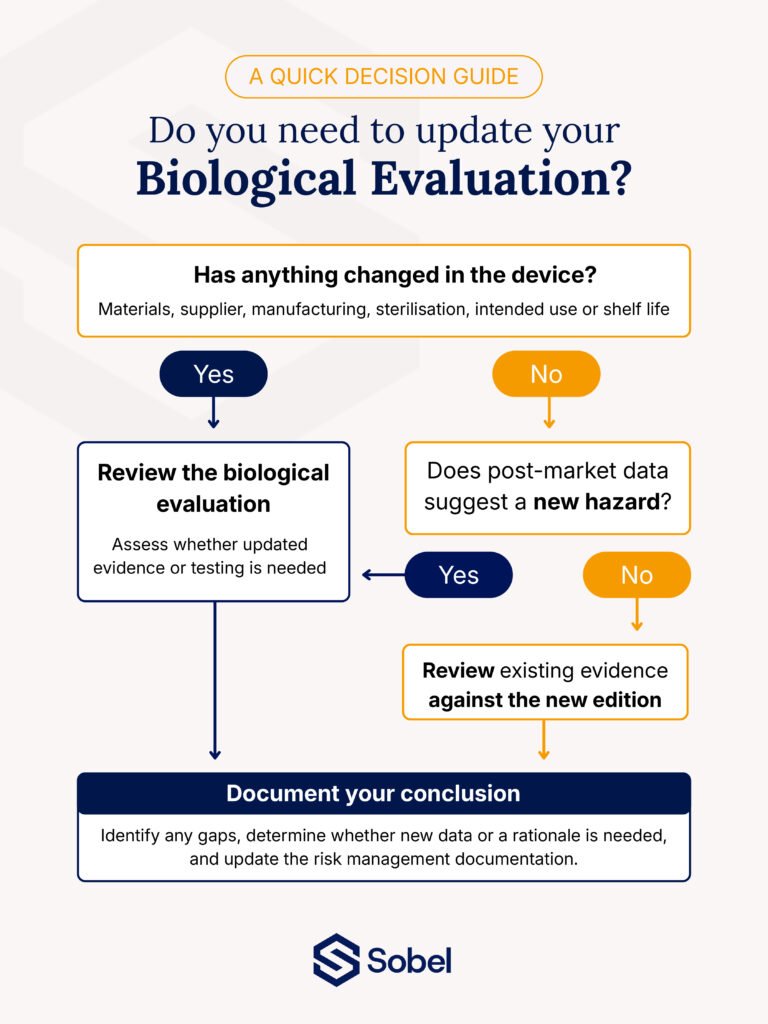
On the other hand, changes to the product may require a new or updated biological evaluation, depending on the device and its risk profile. Examples include:
a change of material, supplier or formulation;
a change in the manufacturing process, packaging or sterilisation;
a change in shelf life or intended use;
post-market data that suggest a new hazard.
Is this you?
Your biological evaluation report still uses the “externally communicating” or “implant” category.
You manufacture infusion sets or other devices with an indirect blood path.
You have a registration, a change submission or a GMP inspection planned in the coming months.
If you answered yes to any of these questions, it is worth reviewing your biological evaluation now.
When will ANVISA review your biological evaluation?
RDC 848/2024 states that ANVISA verifies compliance with the essential requirements during registration or notification, GMP inspections and market surveillance. In our view, the new edition may become relevant at each of these points, and also in change submissions:
Registration or notification: the biological evaluation in the dossier should demonstrate that the current state of the art has been considered, including the impact of the new edition where applicable.
Change submission: if the change involves a material or a process, we recommend that the updated evaluation already considers the new edition.
GMP inspection (Boas Práticas de Fabricação, BPF): the inspection may review whether the risk management file considers changes in the state of the art.
Market surveillance: the documentation should be available and up to date.
In practice
A Brazilian manufacturer of infusion sets changes the supplier of a PVC component. A change of this type will usually require the biological safety evaluation to be reviewed. However, the old report used the lighter indirect-blood-path category of the previous edition. For this reason, the review may identify effects that were not addressed before. A gap analysis performed before the change submission can reduce the risk of technical requirements from ANVISA and delays.
Why not leave the update for later?
In our experience, some companies are not yet treating this transition as a priority. The problem is that the consequence usually appears exactly when an opportunity arrives: a new registration, an urgent change, a distributor abroad. The company has the technical capacity to meet the requirements. What it often does not have is enough time to update the biological evaluation and organise the documentation before the opportunity closes.
In addition, biological evaluation is not only a technical and regulatory obligation. It is also part of how a product earns trust. A current, well-documented biological evaluation shows that the company knows its materials and its patients. In short, for the product and for the brand, this is a foundation, not bureaucracy.
How to prepare for the new NBR ISO 10993-1 in 5 steps
First, list all body-contacting devices and the edition of the standard used in each biological evaluation report.
Next, re-categorise each device with the four new body contact categories.
Then, compare the effects addressed with the new tables, and mark each gap as “needs data” or “needs rationale”.
Record the assessment of the new edition in the risk management file, as part of your state-of-the-art review.
Finally, give priority to devices with a registration, change or inspection planned for the coming months.
Sobel Consult reviews biological evaluation plans and reports against the new edition of the standard. We identify which gaps need new data and which need only a documented rationale. Talk to our team before your next registration or change submission.
What document does ANVISA expect for biological safety?
In a public webinar, ANVISA indicated that documentation demonstrating biocompatibility should be presented, preferably as a biological safety evaluation report. In some cases, this report can be based on literature.
Does my existing registration lose its validity with the new NBR?
No. A new edition of a technical standard does not, by itself, cancel existing registrations. However, we recommend considering it in new submissions, in changes to the device and in the periodic review of the risk management fil
Has ANVISA published any rule on the new NBR ISO 10993-1?
As of the date of this article, no. The relevance of the new edition comes from RDC 848/2024, which requires manufacturers to assess the impact of changes in the state of the art on risk management. Sobel’s interpretation is that the new NBR is a relevant input to that assessment.
To provide the best experiences, we use technologies such as cookies to store and/or access device information. Consenting to these technologies allows us to process data such as browsing behavior or unique IDs on this site. Not consenting or withdrawing consent may negatively affect certain features and functions.
Funcional
Always active
The technical storage or access is strictly necessary for the legitimate purpose of enabling the use of a specific service explicitly requested by the subscriber or user, or for the sole purpose of carrying out the transmission of a communication over an electronic communications network.
Preferences
The technical storage or access is strictly necessary for the legitimate purpose of enabling the use of a specific service explicitly requested by the subscriber or user, or for the sole purpose of carrying out the transmission of a communication over an electronic communications network.
Statistics
The technical storage or access that is used exclusively for statistical purposes.O armazenamento técnico ou acesso que é usado exclusivamente para fins estatísticos anónimos. Sem uma intimação, conformidade voluntária por parte do seu Fornecedor de Serviços de Internet ou registos adicionais de terceiros, as informações armazenadas ou recuperadas apenas para esse fim geralmente não podem ser usadas para identificá-lo.
Marketing
The technical storage or access is required to create user profiles in order to send advertising, or to track the user on a website or across several websites for similar marketing purposes.
Para fornecer as melhores experiências, usamos tecnologias como cookies para armazenar e/ou aceder a informações do dispositivo. Consentir com essas tecnologias nos permitirá processar dados, como comportamento de navegação ou IDs exclusivos neste site. Não consentir ou retirar o consentimento pode afetar negativamante certos recursos e funções.
Funcional
Always active
The technical storage or access is strictly necessary for the legitimate purpose of enabling the use of a specific service explicitly requested by the subscriber or user, or for the sole purpose of carrying out the transmission of a communication over an electronic communications network.
Preferences
The technical storage or access is strictly necessary for the legitimate purpose of enabling the use of a specific service explicitly requested by the subscriber or user, or for the sole purpose of carrying out the transmission of a communication over an electronic communications network.
Statistics
The technical storage or access that is used exclusively for statistical purposes.O armazenamento técnico ou acesso que é usado exclusivamente para fins estatísticos anónimos. Sem uma intimação, conformidade voluntária por parte do seu Fornecedor de Serviços de Internet ou registos adicionais de terceiros, as informações armazenadas ou recuperadas apenas para esse fim geralmente não podem ser usadas para identificá-lo.
Marketing
The technical storage or access is required to create user profiles in order to send advertising, or to track the user on a website or across several websites for similar marketing purposes.